

Computer Game Design Courses Australia
Courses Learn the skills you need to start work and power your creative career. Explore courses

Why SAE Hands-on, accredited training from industry experts in state-of-the-art facilities. Why choose SAE

Life at SAE We're here to support you and help you thrive. Life at SAE

How to apply Launch your creative career with confidence. Apply Now

What's on Explore the upcoming events at our SAE campuses. What's on

About us Learn about SAE and stay connected with us. About us

Games
Diploma of Game Development
START YOUR CAREER AHEAD OF THE GAME
Available at
Brisbane, Byron Bay, Melbourne, Perth, Sydney
Fees
Diploma of Game Development
Domestic Fees
Entire Course Fee
$22,580 AUD
Diploma of Game Development
International Fees
Entire Course Fee
$27,092 AUD
Duration(s)
2 Trimesters Full Time (Fast Track) Complete your course faster by studying the 7 units over approximately 7 months (2 trimesters).
Diploma of Game Development
Course Durations
2 Trimesters Full Time (Fast Track) Complete your course faster by studying the 7 units over approximately 7 months (2 trimesters).
3 Trimesters Full Time Whilst still classified as a full time study load, you will complete the 7 units over one year. (3 trimesters)
Part-time If you want to take a little longer, that's ok too. We'll help you work out the best study load to suit your needs. Note: Part-time is not available for international students.
We understand that things can change, so you'll have the flexibility to change your study load throughout your course if you need to.
Start Date(s)
Diploma of Game Development
Start Dates
Brisbane
-
February 2022
-
May 2022
-
September 2022
Byron Bay
-
February 2022
-
May 2022
-
September 2022
Melbourne
-
February 2022
-
May 2022
-
September 2022
Perth
-
February 2022
-
May 2022
-
September 2022
Sydney
-
February 2022
-
May 2022
-
September 2022
Entry Requirements
Diploma of Game Development
Domestic Entry Requirements
Domestic students must meet one of the following criteria:
Completion of an Australian Senior Secondary Certificate of Education (your Year 12 certificate) or equivalent; OR
Completion of a Certificate IV qualification or higher (for example a TAFE Certificate IV); OR
Experience-Based Entry – for applicants who do not meet the requirements of entry criteria 1 or 2 above.
Diploma of Game Development
International Entry Requirements
International Entry Requirements
Minimum age requirements
International students seeking admission to SAE must be at least 18 years of age prior to the commencement of their study.
Academic requirements
Successful completion of secondary school studies (assessed as an equivalent of Australian Year 12 secondary studies). Minimum overall pass is required.
English language requirements
International English Language Testing System (IELTS): An overall score of 5.5 or higher with no individual band lower than 5.0 (only the Academic Test is accepted), OR
Test of English as a Foreign Language (TOEFL): 63 overall (internet-based test); OR
Pearson Test of English (PTE): Academic score of 36 or higher, OR
Completion of Year 12 English in an Australian secondary school or college or equivalent with a minimum result of "Satisfactory" or equivalent.
Successful completion of an Academic English program with an SAE-approved Australian-based English partner. Please refer to our SAE International Study Pathways for more information.
YOUR CAREER IN GAMES BEGINS NOW

Learn in a collaborative, studio-based environment where your teachers are also your mentors.

SAE has a range of approaches to learning and teaching that can be activated to provide flexibility in the face of changing circumstances as required, to support student progression regardless of external factors.
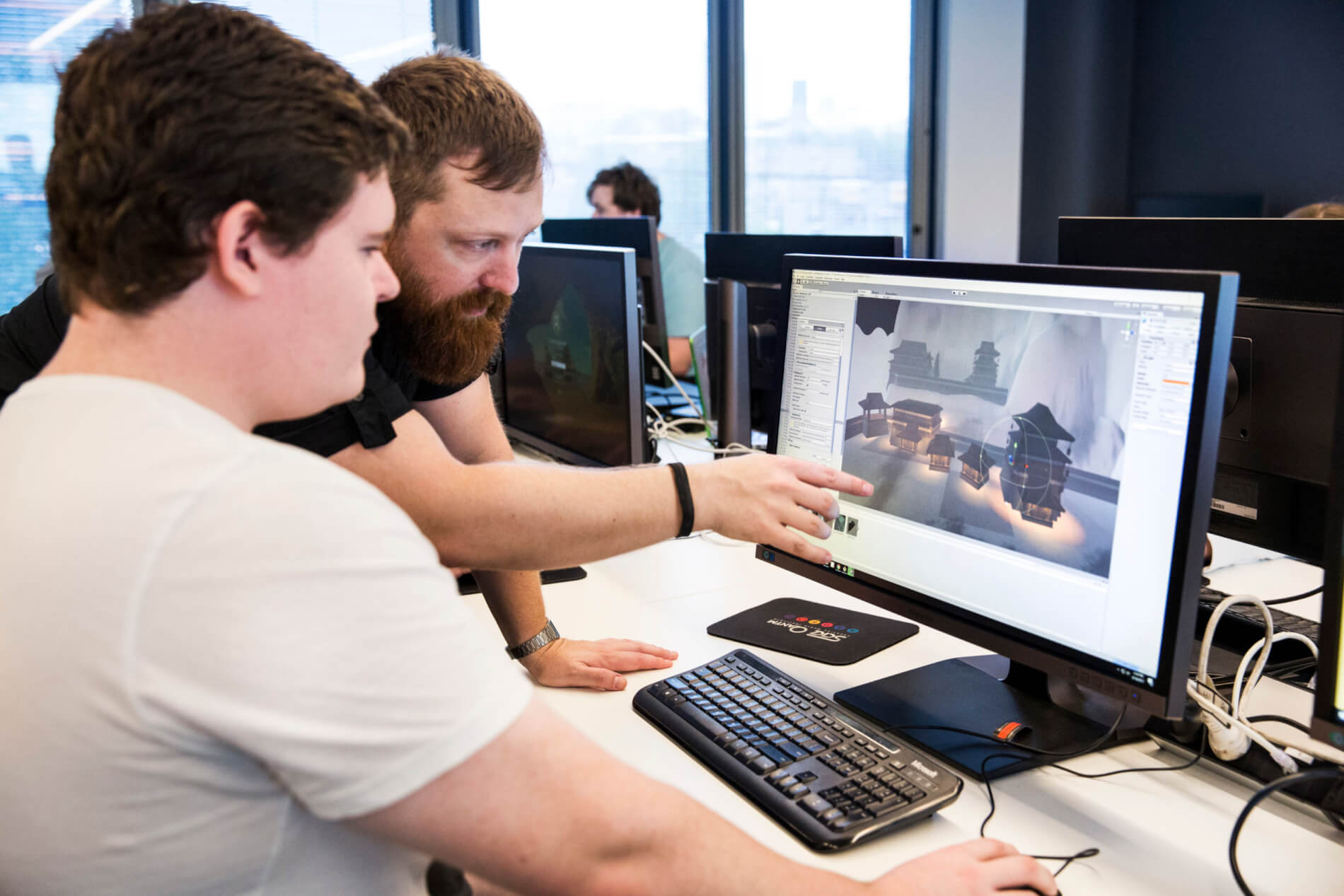
From day one you'll start creating with the latest software and equipment, under the guidance of expert lecturers.
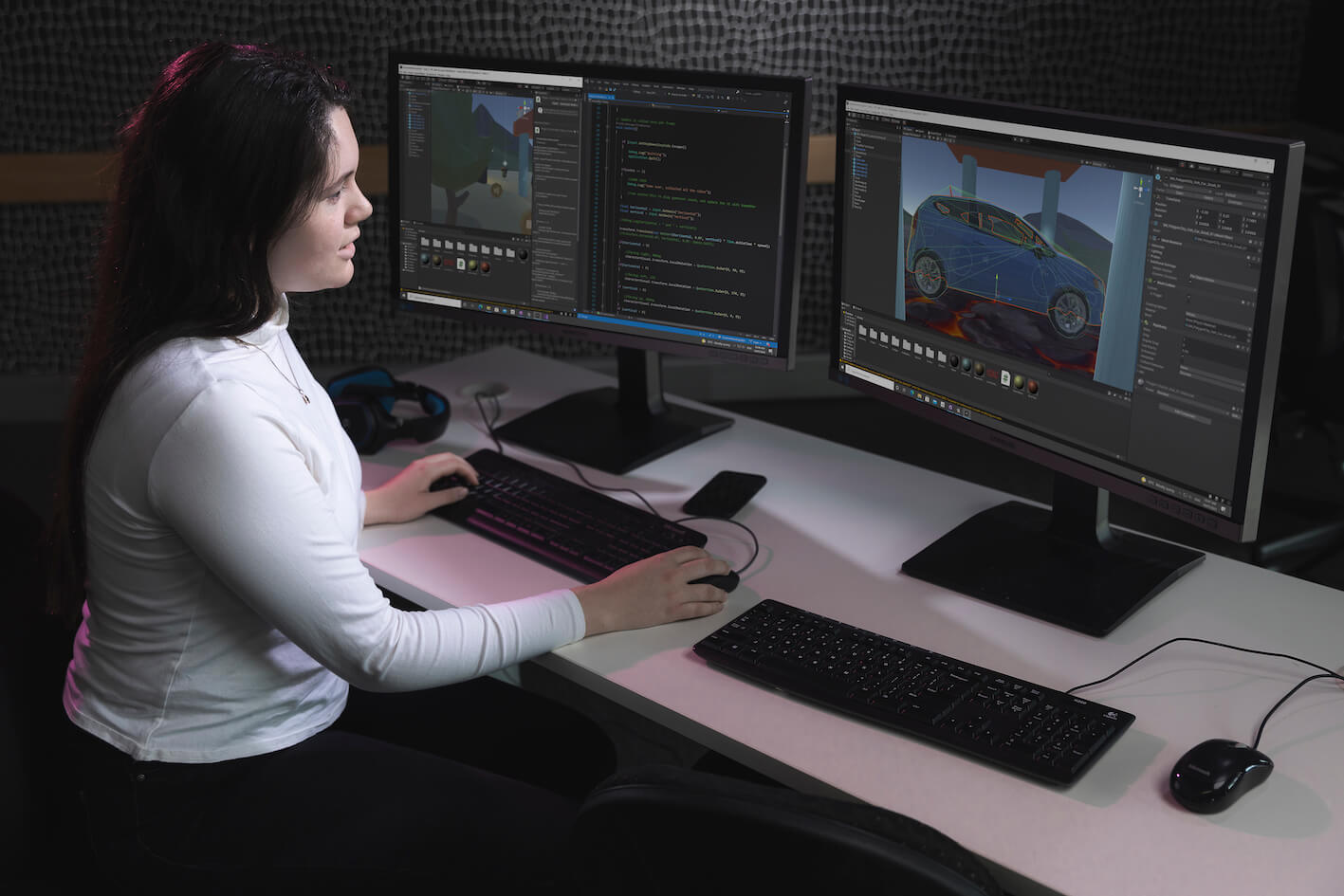
Practical, immersive training All work is project-based, with no exams.
Flexible course options Completing one of the three stages of the Bachelor of Games Development, this course provides an excellent pathway into the degree.
Learn industry-standard middleware and development packages Unreal Engine and Unity.
Become job-ready To complement your technical skills, you will develop communication, introductory project management, teamwork, and collaboration skills.
Basic game functionality Methods for the construction of functional game levels Methods for the modification of game assets Principles of spatial layout Instructional design and user experience design How to write a technical design document
Course Structure
The Diploma of Games Development is stage 1 of the 3 stages of a Bachelor.
Develop the essential technical animation skills and the knowledge required to collaborate with other creative media students and professionals.
Credit Points: 10 Beyond technical and craft skills, expert practitioners also have an understanding of the historical and cultural context of games. Through developing your ability to research, analyse, argue, present, write, and cite games theory, you will become a more literate creative. You'll be able to apply this knowledge and these skills in industry and research settings to benefit your projects and company. Potential projects: Working in a team, You'll pitch an original game concept and the determination of the concept's core design.
Credit Points: 10 Game scripting is a common method of controlling the behaviour and sequencing of events and interactions within a game or scenario. Scripting can be thought of as a discrete language that uses principles of mathematics, combined with rules of syntax and patterns, to provide instructions for a computer to follow. Potential projects:
In this unit, you will implement a range of basic game functionality by utilising data manipulation, formulas, object creation, defining of behaviours, and working with event systems. You will also build an awareness of how to use these elements within common game scripting languages and environments.
Build a simple game from scratch using an existing game engine such as Unity with C#.
Credit Points: 20 In order to design and create games we need to be able to understand game systems and how they generate player experience. In this unit You'll break down existing games to identify and describe core elements and interactions of games. You will also engage with mathematical principles to inform and justify game design choices. This will involve both manipulating existing games and prototyping original game concepts and systems to generate player experiences. Potential projects:
Through a process of iteration and testing, develop an initial modification or an existing game. You will then research and develop this concept into a suitably unique and standalone gameplay experience.
Credit Points: 10 This unit aims to develop your understanding of the creative media industries by studying the evolution of the industries over time. Change, evolution and disruption within creative media industries occur regularly and change the way the industries operate by displacing an existing market, industry, technology, person or process and creating something new which is more valuable. Change, evolution and disruption are inevitable and both creative and destructive processes. In order to develop a career within the creative media industries, you will need to prepare for this disruption and evolve your employability skills over time. The key to maintaining this career is developing hard and soft skills, refining current skills sets and anticipating future changes in required skill sets. You will need to understand how the audience informs and influences the production and distribution of creative media products and how this in turn affects the skills required to succeed within the creative media industries. You will study these topics alongside your colleagues in other disciplines, to develop an understanding of the intersections between various creative media industries.
Games development uses assets from a range of creative sources including 3D models for environments and objects and 2D assets for menus and backgrounds. In this unit You'll gain an understanding of the production and implementation of these types of assets. You'll gain practical experience with 3D modelling, lighting, shading, animation and rendering to gain a foundational understanding of a range computer graphics concepts. You will also reflect on the theoretical principles behind the development of computer graphics through critical analysis.
Credit Points: 20 In order to create games, you must be able to manage the complexity of the game development process. In this unit You'll build familiarity with toolsets and existing industry practices to formulate and execute clear plans for delivering games assets and features on time and of a high quality. Work in a team to pitch, design, plan and deliver a game in response to a brief, where You'll extend your existing skill sets in design and scripting to craft a broader range of gameplay systems and features. This will involve learning and applying teamwork and organisational skills with your your classmates, as well as feedback, testing and iteration processes for the game itself. Potential projects:
Work as part of a team to pitch, design, plan and deliver a game in response to a brief.
CRICOS Course Codes
102830B (2 TRIMESTERS) 094745C (3 TRIMESTERS)
Australian Qualifications Framework
AQF LEVEL: 5 FULLY ACCREDITED BY TEQSA
We consult closely with industry professionals so you can expect a course that's highly relevant and equips you with sought-after skills.

- Entry-level Game Designer
- Entry-level Game Level Designer
- Entry-level Community Manager
- Entry-level Games Writer
- Quality Assurance Officer
- Production Assistant
- App Developer
From gameplayer to graduate
Student game developer excels with hands on approach to learning at SAE
Course FAQs
All SAE courses have a focus on practical, hands-on delivery. The amount of practical time you experience during your studies does vary, depending on your course. You will also have opportunities to access campus resources and facilities outside of class time, during campus opening hours.
Read more about SAE enrolment for domestic students here. Read more about SAE enrolment for international students here. You can apply for SAE courses quickly and easily online. Go to our Apply now page for further information.
FEE‑HELP is a ln Australian Governement loan scheme that assists eligible fee paying students pay all or part of their tuition fees. It cannot be used for additional study costs such as accommodation or text books. The total amount of FEE‑HELP a person can use is known as the 'FEE‑HELP limit'. Once a person begins using FEE‑HELP, the amount of FEE‑HELP they have left to use is known as their 'FEE‑HELP balance'.
View all FAQs
With our industry connections, specialised teachers, and personalised education in world-class facilities, you can unleash your creative future with confidence.
Computer Game Design Courses Australia
Source: https://sae.edu.au/courses/games/diploma-of-game-development/
Posted by: melsonbacte1966.blogspot.com
0 Response to "Computer Game Design Courses Australia"
Post a Comment