

How Much Did The Makeup Artist Make For War Of Thr Planet Of The Apes
If you lot're a filmmaker trying to bring fantastic characters to life with the nearly realistic, lifelike performances possible, you're probably going to desire to talk to Joe Letteri. The longtime visual effects supervisor has been working with computer-generated characters going all the style back to James Cameron'southward The Abyss . As role of WETA Digital, he helped the director bring the Na'vi to life in 2009's Avatar. Peruse Letteri'southward filmography, and it's hard to observe a pic he worked on that didn't interruption significant new footing in one course or another.
Over the by six years, he'due south been part of the Planet of the Apes trilogy, which hasn't just used CG characters to surprise and awe audiences, just to behave the increasingly circuitous emotional weight of the films themselves. The latest installment, State of war for the Planet of the Apes, amps up the story (and the special effects) even further, with Andy Serkis' Caesar heading out on a revenge mission that takes him through extreme snow and other conditions that would take been impossible to create just a few years ago.
I jumped on the telephone to conversation with the affable Letteri about working with managing director Matt Reeves, the challenges of 65mm film, the evolution and iteration of the performance-capture process, and how to create a CG woods that'due south so realistic you tin can't even tell that it's an effect at all.
Making Caesar intermission
Yous worked with Matt Reeves on the terminal movie, Dawn of the Planet of the Apes , but this film pushes th east effects in impressive new directions. When yous sat downwardly to talk well-nigh War , what was his creative mandate?
Well, I remember what Matt was after this time was more of that Exodus kind of feeling. This was really a story where he wanted to take Caesar, and all of us, beyond where we'd been comfortable before. Going all the manner back to Rising, this is a story about a graphic symbol who straddles two worlds. Caesar grew upwardly in a homo household, and pretty much thought he was human, until the world intruded and said, "Now you tin can no longer live with humans." They sent him off to the ape enclosure, and of a sudden he had to find this whole other identity.
But through the first two films, when humans started becoming aroused by the conflict — the fright of what could be happening considering of the apes gaining intelligence — Caesar e'er tried to see both sides of information technology. He ever just tried to bring peace. In the third moving-picture show, Matt wanted to go across that. He wanted Caesar to finally break, to experience that rage he'due south been trying to keep nether command the whole time.
Then he goes to some real emotional depths in this 1 to notice out who he is, and what he'due south got to practice to keep his his tribe alive. And that was really the heart of it. It was more near the performance, and that arc. And then everything we have to practise technically comes out of that. The fact that Matt wanted to go fifty-fifty deeper out abroad from civilization, shooting in the wilds of Canada, and having these large snowscapes and these big vistas; places where doing this kind of highly technical sort of work is hard. Nosotros wanted to push beyond all that to tell this story.


Performance Capture 101
The core technique in building these creatures is recording the operation, and while everybody has seen pictures of actors in crazy suits, it's easy to breeze past what's actually going on. In that location's a beautiful shot where Caesar and a few other apes are riding across the beach on horseback. Can you walk us through the creation of that shot?
For a shot like that, the actors are riding the horses. Normally when you're doing something actually performance-driven, we do operation capture, which is putting up a lot of specialized cameras all around the set to tape the motions from dissimilar angles. The actors are wearing a helmet with a head rig and a petty photographic camera mounted in front end of their face. We use that information to construct the body motions of the apes and the motions of the apes' faces. And so nosotros have to track the horses in place, because everything nosotros do has to fit into the three-dimensional real world that's happening in front of the camera.
So we need to know exactly where those horses are, where every limb is for every frame, because we take to reconstruct that to exist able to paint the actors out, and put [the apes] on height of the horses. Some of it is done with hand painting. Some of it is actually done with CGI horses that are either wholly or partly reconstructed to fit under the apes, because y'all've got different body types. Apes and humans are close, simply not shut enough. So there's a lot we have to reconstruct to brand that conceivable.
And we have to compute all the lighting out there in the real globe. Whether it'south natural sunlight coming in through clouds or bouncing off the sand or off the water, or if there's whatsoever bogus lite that's added. That sequence was shot with natural light. But we have to business relationship for all of that just like you lot do in cinematography, match all the camera moves, and then we start this intense round of computation to run everything through the computer and make sure it all does the right matter. That the fur simulates the right way. That the light bouncing all around in that virtual world matches upwards to the light billowy around in the real world, then we can composite all the elements together. And once you lot do all that, you should come out with your shot in the end.
And what is Matt working with on set? Is he looking at a previsualization of what it volition wait similar with the apes composited in, or is he but working with the actors?
Just worried nearly the actors. The thing that's really good well-nigh these Apes films is that the chimps and humans are more than or less the same size, so nosotros tin frame them as they need to exist. You don't have to practise a visualization to imagine, "Well, what is this going to await like?" Because it'southward not a 25-foot-alpine grapheme. Also, the photographic camera operators can concentrate on the movement of the actors, because what they shoot is exactly what's going to exist in the moving-picture show for framing. It's also great for the editors, because they have exactly what the actors are doing to piece of work from for their cutting.
How has the performance capture procedure evolved as y o u' ve been wo r king on the se films ?
The big breakthrough came on Rising of the Planet of the Apes when we figured out how to do this live, and take it coexist with the rest of the motion motion picture photography. Up until then, performance capture tended to exist an after-the-fact process. Andy would go out and practise his scenes on set — say, when nosotros were doing Gollum — and whatever selects we'd like, he'd go back and do them in a separate volume [a motility capture phase]. And so the ability to capture those performances simultaneously with all the other actors was something we actually pushed for on Rise.
Once you accept that freedom, you desire to take information technology further and further. And that's where Matt really pushed this. On Dawn, out into the wilderness, out into the rain, a petty farther from civilization. And then on War: actually far out from culture. Harsh, moisture, common cold conditions. Only you're capturing subtle, nuanced performances, then the gear has to perform. There'southward a whole coiffure there to back up gathering all that information.
So there are technical breakthroughs, just they're all behind the scenes. They take to practice with getting better ways of connecting the systems and calibrating it, and putting wireless together to make certain the data all comes through without whatsoever dropouts. Simply the fundamental aspect of how it works is yet basically the aforementioned. You're just trying to tape every possible angle of what the actors are doing and so you tin reconstruct information technology later.
:format(webp):no_upscale()/cdn.vox-cdn.com/uploads/chorus_asset/file/8869537/AEB0040_v0202.1180_MKT_rgb_2040.jpg)
Harsh conditions ahead
The fur on these characters isn't put together by hand for every frame. You're using intense computer simulations that determine how it moves. Only yous're as well putting Caesar in farthermost atmospheric condition like snow and rain. How does that complicate the procedure?
Fur is complicated. Y'all've got millions and millions of little fibers that all have to react to gravity, and to themselves, and to all the lighting. At that place'due south lots of simulations going on. Then they get wet, water runs off the fur, that adds another layer of complexity. When they're rolling effectually in the snowfall, or snowfall'southward accumulating, it gets fifty-fifty more complicated, because snow packs on the fur. Y'all think you lot empathize the physics — now it gets compounded by calculation these icy packs that are constantly evolving and flaking and falling off.
We take to run a whole extra level of simulation to make all of that work. Plus snow has a fashion of affecting the lighting on the fur, and that all has to get computed too. So yes, nosotros do a lot of physical simulations, and also light transport, to arrive at both the right movement and the correct photography.
Did that require a new circular of software evolution?
A few years agone, nosotros started writing our own renderer, which we call Manuka. It'southward the software that computes all the lighting in the scene, and all the surface characteristics, and bounces all the light around, and computes what gets to the sensor, and what the pic should expect like. So it'south the digital version of photographing your scene.
We broke information technology out for the beginning fourth dimension on Dawn, but because information technology was so new, we didn't throw the close-ups at it. Nosotros merely did it for the background characters, considering information technology was good at handling big scenes with big amounts of fur in them. Simply on this film, we finally have pushed information technology far plenty, and got it robust enough, to practise all the close-ups with information technology. So I think y'all'll run across the difference when you await at the close-ups in this film, vs. what you saw earlier in Dawn.

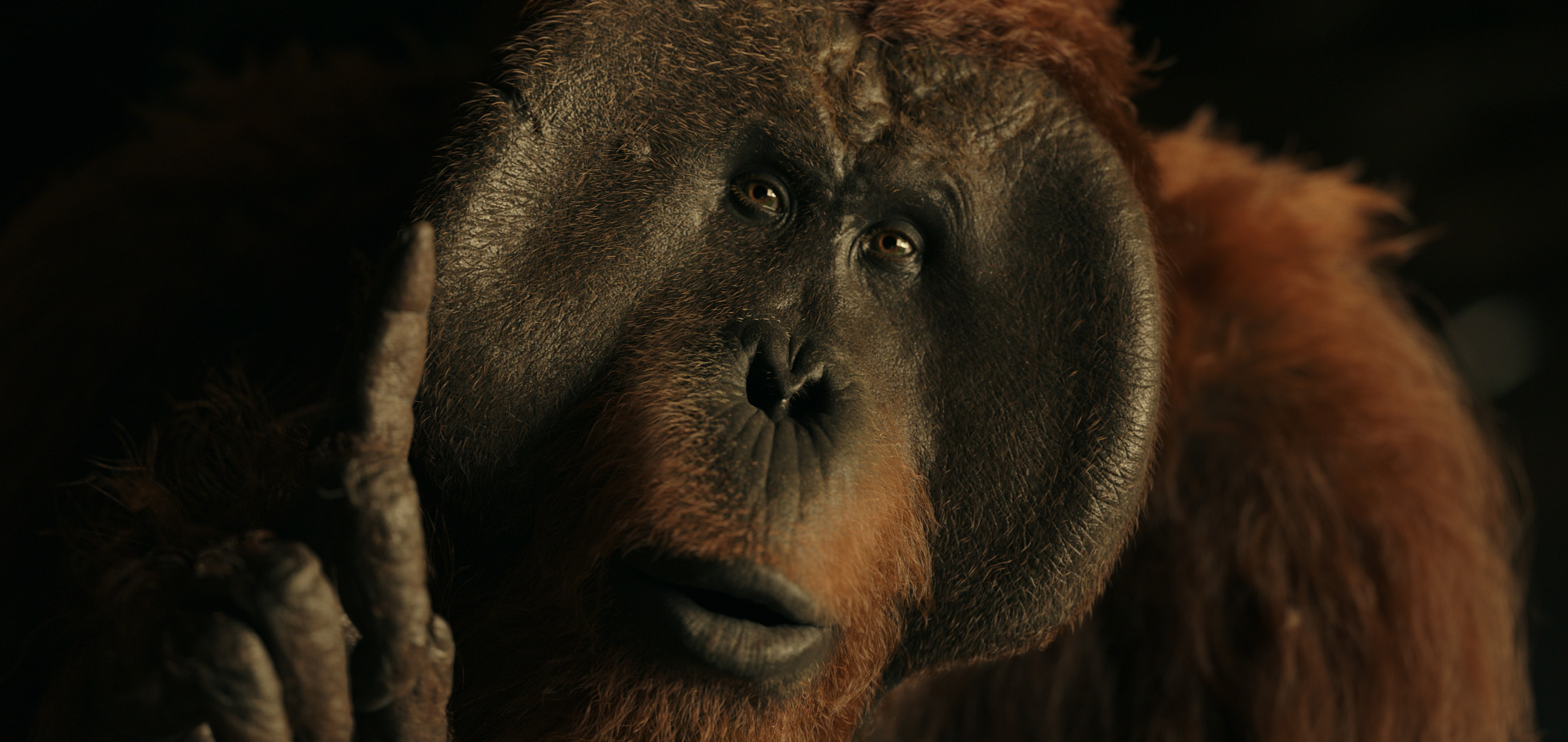
There's a shot with Maurice looking at a young girl (Amiah Miller) that was so realistic , it actually bumped me out of the film for a moment, merely to gut-check myself. Just there's also a lot of nuanced operation work for Caesar. How much of that is Andy, and how much of that becomes the animators?
From the beginning, going dorsum to Rise , we knew the apes would exist completely digital. We didn't wait at doing anything with prosthetics, because the whole signal of the story was, they had to look realistic, and so you lot would believe it when they offset to evolve. Then the combination has always been, you've got the role player's performance, but what you run across on the screen is fully digital. The emotional drama is there. Information technology'due south given by Andy; it's given past the other actors.
Where nosotros would step in is, things that can't be captured, or that need to be adjusted considering of differences in the apes. As much every bit the actors railroad train to do the proper ape move and ape beliefs, there are however differences. Human being legs are longer than ape legs, and arms are shorter. So there are always slight adjustments. You lot lower the hips a piffling so it works with the longer legs, which means the shoulders are in a different position, just you've got to become the head right back to where it was, and so the eyeline works and the attitude works. So equally animators, those are the kinds of things we're trying to do so you don't think about the differences betwixt humans and chimps.
:format(webp):no_upscale()/cdn.vox-cdn.com/uploads/chorus_asset/file/8869533/7_MKT0924_v0051.1001_MKT_rgb_2040.jpg)
Working with 65mm
Matt Reeves has said he wanted this film to feel like an former epic, or a David Lean film. One of the ways he got that feel was shooting on 65mm movie. How did that touch your piece of work on the visual furnishings side?
It's like anything worth doing: in that location is always extra work involved. It's a great format. It's widescreen, just it's got shallow depth of field. Which is cute for the photography. Information technology's great for really getting that separation between characters, and between foreground and background. Information technology's got a tremendous filmic quality, merely when you're dealing with having to paint actors out and supercede them with digital characters, the more y'all have to work with, the amend. Technology always wants yous to have the simpler thing, considering that makes life easier. Simply creativity wants y'all to accept the more than complex thing. And creativity e'er wins. It's like, we'll figure out the technology if that's what Matt wants the movie to look similar, and that'due south definitely what he had in heed.
So you're maxim shallow depth of field makes it harder to paint an actor out of a shot because they might exist out of focus?
It does. Y'all were saying before: actors on horses. Then say y'all've got a whole bunch of actors on horses, and you've got to paint out the actors' legs to put the chimp legs on the horses. Now the actors' legs are longer, then in that location's always some of the horse that you've got to paint back to track back in. So if this is in the groundwork, and that little bit is out of focus — well, how do you know exactly that you've got the track working for the digital horse torso yous're putting in? Because they have to friction match up hair to hair. So yous can't see it by looking at the frame; you accept to play it back in motility and merely use your sentence.
You would think that information technology beingness slightly soft means it's more forgiving, just it's actually non. Because you can nevertheless perceive if anything is sliding, you but don't have annihilation to lock into.
:format(webp):no_upscale()/cdn.vox-cdn.com/uploads/chorus_asset/file/8869543/hft_shots_boh_0350_610.1311_rgb_2040.jpg)
Simulating mother nature
W chapeau about the environments ? Was annihilation there a particular challenge?
Yeah, 1 of the things nosotros did on this film was, we grew the pino forest up behind the fortress [where the climax of the film occurs]. In the by, we've built lots of jungles, and copse have incredible diversity. The modelers have to make each tree past hand, and it'south a actually time-consuming process. And then you art direct them into place to endeavor to get the whole layout to wait natural.
What happens with copse is, they don't abound isolated. They abound in groups, and the aforementioned species of tree will give yous an space amount of differences, depending on how they abound. So we've written a organization we telephone call Totara. Now, rather than growing trees 1 by one, nosotros grow them in groups, so they compete for resources. The older ones overtake the smaller ones. Sunlight and shadow determines which side might get more than branches, which side doesn't. And the finish effect is, nosotros build the terrain, and then we sprinkle a bunch of seeds around, and then we run a simulation that lets the trees grow for a few hundred years. And when you look at that, yous go something that immediately looks natural, as opposed to something that looks similar you built a forest from a lot of individual trees. Hopefully that's something people don't notice, because it should feel completely natural, but it'south a whole new way of budgeted environments.
Source: https://www.theverge.com/2017/7/18/15988096/war-for-the-planet-of-the-apes-joe-letteri-visual-effects-interview
Posted by: melsonbacte1966.blogspot.com
0 Response to "How Much Did The Makeup Artist Make For War Of Thr Planet Of The Apes"
Post a Comment